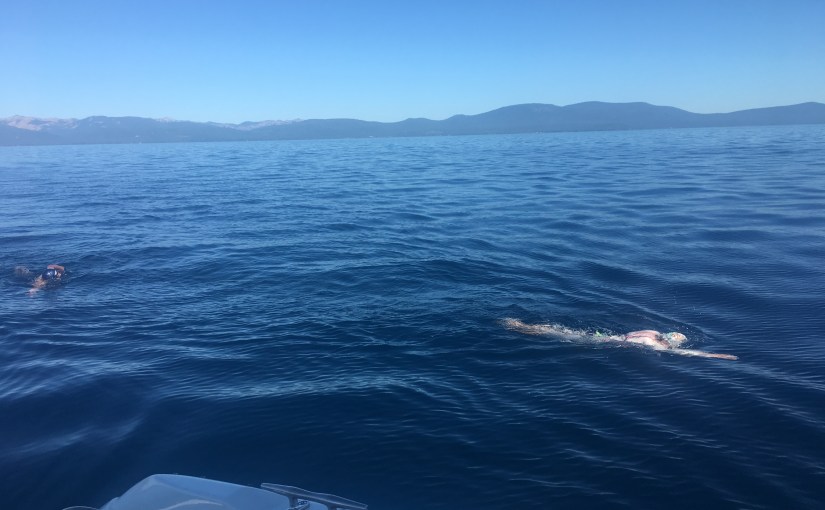
Note: I’m not sure this ever got officially “published”. I’m publishing now, almost 3 years later, because it’s a good story that really happened to me.
We got up at 1:30am on Friday morning, after going to bed at about 9pm. I doubt I slept more than 45 minutes at a stretch during the “night” and it was rough going. Eyal made coffee, and I made 2 pieces of toast with almond butter, goat cheese and honey. We put coffee in our mugs and by 1:55AM we were in the car heading to Camp Richardson.
On windy roads, I get motion sickness unless I’m driving, and the road from Tahoma to Camp Richardson is nothing if not windy, so I drove. The highway is narrow and the trees encroach on the pavement, and in the middle of the night, it was like driving through a tunnel. Eyal was awesome—he made light conversation and basically kept me awake!
We got to Camp Richardson and moved our gear to the boat where we were greeted warmly by Sylvia and Bryan, and Bryan’s 17 year old son Nick. Bryan was coming off of 7 hours of “compensation” sleep from doing a Tahoe length crossing the night before and he was hale and hearty. Our observer from Northern California Swimming Association, Kat Finlay, was also onboard, cocooned in a fuzzy blanket. The night was beautiful and clear and we all watched the sky for shooting stars leftover from the Perseid meteor shower of the prior week while Bryan got the boat ready.
After going over the rules, expectations, and communication signals, we started across the lake from Camp Richardson to the Cherry Street steps in Homewood, the swim’s official starting point (and only 2 miles from where we were staying!—a last minute change in the boat’s assigned mooring from Homewood Marina to Camp Richardson meant we had to go in and out of Camp Richardson). At this point I started to shiver, not from cold but from anticipation and apprehension. When we were about 5 minutes out, Sylvia put Desitin all over my back, legs, arms and face, and attached a beacon to my head (red) and a glow stick to my suit (green). These lights matched the lights on the boat (red in the front, green in the back and purple at the very back of the boat) and were designed to make sure they could tell where I was—and that I hadn’t gotten turned around to swim the wrong direction.
I kind of wanted the preparations to last forever, but in no time Bryan was telling me to jump off the boat. I knew the water temperature was fine for me—I swam for 30 minutes at the beach across from our rental on Thursday—but jumping into the dark water in the middle of the night off of a perfectly good boat seemed like a crazy idea. I sat down on the swim deck on the back of the boat and slid in, like a seal.
The water was like velvet. How often have you read that phrase? It sounds clichéd but it described perfectly how the water felt. Maybe not as warm as velvet, but like velvet that had been left in the shade of a tree—slightly cool, and smooth and really quite comfortable. I swam to shore and got up, shivering (from cold now) onto the steps at Cherry Street and waited for Sylvia to flash the strobe—and then I waded in and started swimming.
It was my first time swimming in the dark. At a panel discussion a year or so ago, I asked Karl Kingery what it was like to swim in the dark, and said it was one of my fears about long distance swimming. Karl replied, quite reasonably, that I should try it and face the fear. Of course I didn’t and in fact in planning the swim, told Sarah Thomas I was just going to try to survive the darkness—I figured it would only be completely dark for about an hour and I wasn’t scheduled to eat until after an hour so I could just put my head down and swim. But swimming in the dark—rather than being terrifying or disorienting—turned out to be one of the highlights of the swim.
In open water swimming I usually feel I have no frame of reference. Unlike swimming in the chlorine box, swimming in a lake or ocean means there are no lane lines, no obnoxious swimmers that you feel the need to swim faster than, and no pool walls. This means that I (at least) can’t tell whether I’m swimming fast or slow and often can’t even tell if the current is pushing or pulling, unless the current or chop is particularly aggressive or lumpy. Swimming in the dark in open water takes “no frame of reference” to a high art form—I could have been in an infinity pool for all I knew, and in a way I felt a kind of freedom I don’t always feel when I’m striving in an open water, daytime swim.
It reminded me of the Outward Bound Relay in 2006, which I ran with some friends from Idaho Springs to Glenwood Springs. I was the runner on deck at 1:30am for a 10k leg of the relay that went through Vail. It was September, but cold and snowy, and we were running primarily on the Gore Creek Trail through Vail. Headlamps were useless because of the snow and parts of the relay leg I actually ran briefly with my eyes shut. It turned out to be my fastest relay leg—either meaning I should always run with my eyes shut or, more likely, relaxing during challenging physical conditions puts you in touch with a different level of consciousness that enhances your performance. I felt the same way about the night swim in Tahoe.
At some point, the sky turned from black to a lighter shade of gray, which gave way to pink. Eyal captured the beauty of swimming into the sunrise in the video:
After that a few things happened. I ate, on what felt like way sooner than 30 minute intervals. And I swam. Eyal was awesome and he would give me a report on my stroke count, and tell me who was checking in on Facebook and sending their positive vibes. Swimming, swimming, swimming, feed, swimming, swimming, swimming, progress? I tried to avoid looking ahead at the far shore and mostly succeeded in doing that, but it felt like forever—although it was probably just a matter of 2-3 hours or so. Then I encountered some chop and riffles, and suddenly it was like I was in a slipstream. I felt like I was flying, and indeed when Sylvia stopped me to eat she told me that I’d caught the current that happens sometimes in Tahoe, exchanging cold water down below for the warm water on top, and it was pushing me along.
The current (sadly) was temporary. Sylvia had said my mind would be like “swiss cheese” by the end, but it was swiss cheese long before that. Before long, I totally lost track of how many feeds or how long since the day had broken. I was relieved when Eyal jumped in the water to swim with me for around an hour. Under open water swim rules he had to swim behind me, but it was still nice to have a little company! When Eyal got out, I thought I could see buildings on the Nevada shoreline, but Sylvia and Bryan told me not to get my hopes up. At that point, I was getting tired and my right arm was getting lazy. Bryan said “focus on your fingers” because I was shortening my stroke in a bad way. That helped and gave me something to think about.
Then on a stop to feed, Sylvia said, “I hope you brought your poker chips, because we just crossed into Nevada!”
I know now that she meant this to be positive and encouraging because at that point we only had 3.3 miles left. But for the life of me, I couldn’t remember how much of Tahoe is in Nevada and how much is in California. The default (in my mind at the time) was that I must have 6 miles more to go. Oh no! I was so discouraged, and I think my face showed it—Sylvia looked surprised. The problem was that while my head was telling me I had another 3-4 hours, I could look ahead and see the shoreline clearly. From swimming other point-to-point swims—admittedly not as long as this one—I had the feeling what I was seeing was a lot closer than 6 miles, but I wasn’t sure. This was the most difficult part because, as I always knew, the biggest challenge for me on a 12 mile swim was going to be mental not physical.
I decided to just live in the moment—even if I was going to swim 4 more hours, at some point I was going to be done swimming across Lake Tahoe and I’d have to get out and go on with everything else in life, so I decided to just really enjoy swimming in Lake Tahoe, no matter how long it took. I thought of Sarah Thomas’s story about getting discouraged during her Lake Powell swim last year—one thing that kept her going was realizing that really, nothing hurt and there wasn’t any real reason to stop. This thought worked pretty well and I went through a few more feeds and then Sylvia said, “last feed, you will finish after this”, and with that I was 1200 yards from shore. I was suddenly so tired. The video Eyal took at that point shows it—my stroke count dropped a bit as I swam through the moored boats to the front of the pumphouse. I swam and swam and swam, like I do in at the end of the Teal Lake race every summer in Michigan, waiting to touch the sand during a stroke before I stood up. Finally, I did touch the sand and got up and staggered—literally—to shore, went above the high water mark, and then put my arms in the air. I could hear Kat, our observer, shout “clear” (meaning I was high enough on the beach to satisfy open water swimming rules). Done!
Then I swam back to the boat and ate the leftover pizza from two nights previous, and felt marvelous. Really. Nothing hurt, I was tired and a bit goofy and very glad to be done, but I felt great.
Things to know for the next swim. The actual feeds worked great. I used Infinite Open Water Mix and Tailwind orange (with caffeine). I also had Advil twice—two pills maybe half way across (when my shoulders were very tired, thanks Sarah Thomas who was communicating with Sylvia and Eyal and recommended it) and then another 2 pills another 90 minutes later. No stomach upset. I had some Scratch orange chews (my all time fave sweet thing during a swim), applesauce, and a little bit of a Three Musketeers candy bar. If I could have found it, I would have tried warm Tang to start with—the thought of warm orange drink when I am cold is very appealing and would have been great to try during the cold morning hour. 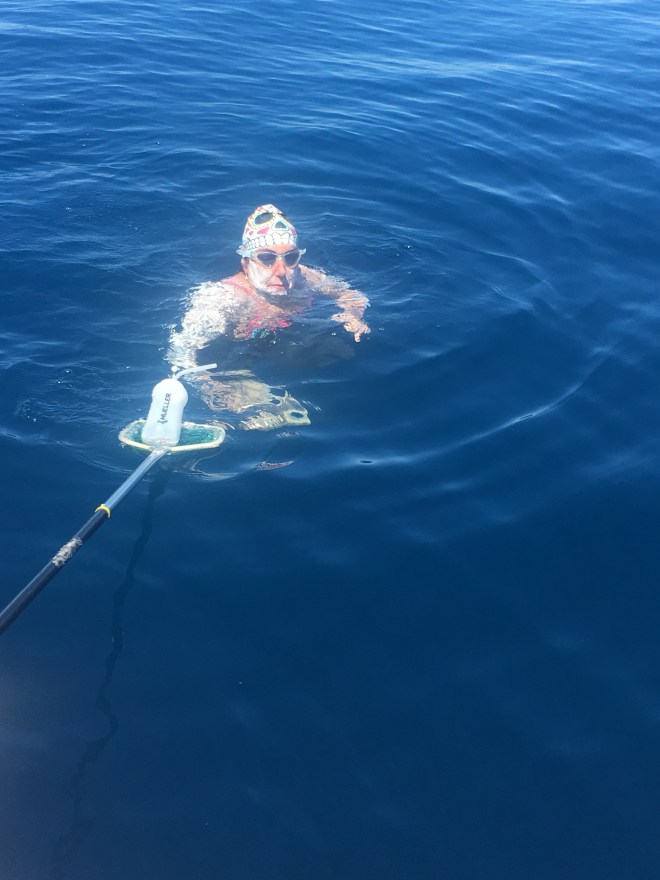
The feed delivery situation has to be different next time. Bryan and Sylvia used a net to supply the feeds which was great in a way (no worries about being hit in the head by the flying bottle), but bad in another way, because I had to swim to the boat to feed. Or maybe I shouldn’t have tried to swim to the boat to feed–and instead just swam with the boat closing the distance. Either way, Eyal and I figured I spent about 75 minutes of the swim (total of 8 hours, 36 minutes) feeding. If I could be more efficient feeding I could finish sooner.
I also had trouble peeing—sorry—but it turns out that no matter how many years I am swimming in open water, this is still a challenge. I think I spent another 15-20 minutes trying to pee.
That still makes it a slow swim, but if you deduct the feeds and bathroom breaks, not that slow.
When I got on the boat, Kat and Sylvia I was amazingly consistent–my stroke rate had been like a metronome all the way across the lake, hardly varying from 56 strokes/minute. Bryan asked what was next and I realized that, unlike when I swam my first 10k a few years ago, this swim had not immediately wakened in my a desire to swim further. After finishing the Wellington Castle 10k in 2016 I thought–I can swim farther than 10k! and that set me on the path to Lake Tahoe. I still don’t know if I can swim farther than 20k and more importantly, I don’t even know if I want to. Bryan suggested it’s like child birth and you forget how hard it is and that makes you want to do the same thing or more again, but I’m not sure yet. Definitely more open water swimming–maybe in SF Bay from the Bay Bridge to Golden Gate, for example. But further than 20k?? Not sure yet.
 Swimming in the Slipstream